The Clovis Point Story
from chapter three
"The Many Coups of Lame Beaver"
of the book "Centennial"
by James Michener
In the year 9268 B.C., at the chalk cliffs west of Rattlesnake Buttes a human being twenty-seven years old, and therefore ancient and about to die, studied a chunk of rock which a younger man had quarried from the mountains. He was a flint-knapper, and his practiced eye assured him that this was the kind of he needed, a hard, flinty, gray-brown rock with one facet fairly smooth. It was about the size of man's head, and most of the memorable rocks he had worked with in the past, those he had remembered with affection because of the superb points he had struck from them, had looked like this. He breathed deeply and felt there was a good chance this one might prove productive too.
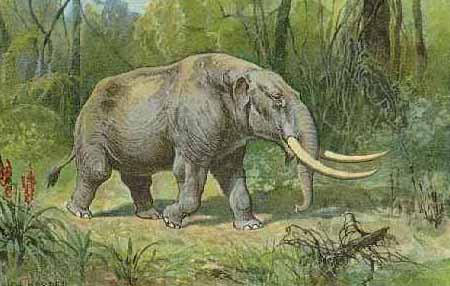
But he was also apprehensive, for the hunters of the clan had gone almost two months without having made a major kill and food supplies were low. Scouts had spotted a small group of mammoths, those formidable beasts that stood twice as tall as a man and weighed a hundred times more, but to kill such an adversary required the stoutest spears, tipped with the sharpest point, and its was this flint-knapper's task to provide the latter, for upon his skill depended the security of his clan.
Before he risked breaking into the secret of rock, he purified himself, for he knew that no man could succeed in a venture of great moment without the aid of the gods. Leaving his work space - a flat area at the foot of the chalk cliff - he went to an opening between the trees and there turned his face upward and his body to each of the four compass points, ending with the east, from which the sun came. He engaged in no complicated ritual and uttered no incantation; he merely wished to inform the gods that he was about to engage in a project of great importance to the clan, and he solicited their attention. He did not grovel for assistance, because in that large area there was no better knapper than he, but he did want the gods to be aware of his undertaking and to refrain from interfering.
He then went to the running stream that came out of the mountains to the west of the cliff and washed his hands, applying some of the water to his face. He was now ready.
As he walked back to his work area he was indistinguishable, except for his dress, from other men who would occupy this land ten thousand years later. He walked erect, with no apelike bending at the waist. His arms did not dangle and his head was not massive in proportion to the rest of his body. There was no conspicuous ledge of bone above his eyes and his hands were, as we shall see, beautifully articulated.
His eyes had a slight slant, an evidence of his Asian ancestry. His face was somewhat heavier than those of later men, his cheekbones more pronounced, his skin several shades lighter than that which was to come later; it inclined, perhaps, more toward red than yellow, and in this respect was quite similar to the men who would follow.
He had a working vocabulary of twelve or thirteen hundred words, few of which would be intelligible even a short time after his death, for in language swift change was in process. He had considerable powers of thought, could plan ahead, could devise tactics for hunting which required cooperative movements carried out at spaced intervals, and he knew a good deal about animals, the nature of the differences between women and men, how to rear children, how to lay by enough food in good periods so that he would have something to eat in time of famine. He worked hard and understood that if he got ahead in his production he would have time for his own enjoyment.
He did not take himself too seriously, he was not lugubrious even when talking to his gods. Often he burst into laughter when his children did something ridiculous. From time to time, in making the projectile points on which his clan depended for their existence, he felt pride in being an artisan, a man trained to accomplish, and such a feeling came over him now.
"If I get a good start," he told his apprentice, who must soon be making the points himself, "I can strike ..." and here he held his ten fingers aloft twice.
What a tremedous statement to have come from the mouth of a primitive man! How totally compelling in its complex range of thought! A man at the dawn on history who could utter such a complicated concept could produce children for whom anything would be possible.
If is a word of infinite intellectual significance, for it indicates actions not yet completed but with the possibility of alternate outcomes. To get a good start implies memory of bad starts and how they differed from the good; it implies also that there will be consequences stemming from the good start and that they will be consistent with such consequences that happened in the past. The incompleted I can strike... is the sum of man's experience on earth, the promise of completed action in accordance with known desires. And the ten fingers held aloft twice is an advance in mathematics so profound - an abstract number without a name - that all subsequent analytical thought will be based upon it. To visualize twenty points being attainable from a roundish chunk of rock, and to have number for them and to recognize that that number goes beyond the digits of the hand, is an accomplishment of such magnitude that it must have required man most of the two million years he had so far lived on earth to assemble that experience that would justify such a conclusion.
The knapper who prepared to strike the rock that day had all the innate capabilities that future men would have; the only additional component required to produce a complicated society would be a sufficient passage of time and the patient accumulation of memory. But this man had something else that would always be precious in whatever epochs followed: he had an innate sense of proportion, design and beauty, and the degree to which he had those qualities would never be surpassed by any men who followed him on this spot.
Coughing twice, rubbing his fingertips on his chest, he lifted the heavy rock and studied it for the last time. It met his specifications, for it was vitreous, totally homogeneous, without any tendency to fracture along a predetermined plane, and of the same construction along all axes, which would permit to fracture equally well in all directions.
Making a finished point required four quite different steps, each performed with a different tool. First he must transform the amorphous rock into a truncated cone. Now, obviously the knapper could not possibly have known the mathematical properties of a cone, nor the physical princples governing it, but he had learned from experience that if his rock did not assume a conical shape, it would not yield the flakes he sought, but if it did approximate a cone segment, the flakes would fly off in a dazzling sequence.
His first tool was a smallish, rounded rock with curious characteristics. It was ovoid and of a grainy texture, with a certain amount of yield. It was the possession he prized the most in his life, for a responsive hammerstone was almost irreplaceable. One morning he advised his assistant, who was seeking such a stone for himself, "You must find one that talks back".
With his hammerstone he knocked away unwanted portions of the flint and coaxed it into a conical form. When it was prepared, he worked carefully with his hammer, building the right kind of edge along the top surface. Then, after careful study, he struck one particular spot, and the force of the hammer radiated downward but with a slight lateral effect, and a beautiful flake as long as his hand leaped from the surface of the cone. Dropping his hammer, he held the flake to the light and satisfied himself that it contained no telltale lines of fracture. It was fearfully sharp along the edges and as it then stood it could have been used for a knife, but he intended working on it later to form a projectile point.
What happened next astonished even his helper. Working radidly, and revolving the core so that always a new face was exposed, he struck with his hammerstone almost as fast as a woodpecker pecks a dead limb, knocking off one perfect flake after another. Then he paused and worked slowly, building up the edge so that it would catch the hammer blows properly, and when this was done he resumed his woodpecker taps. Nineteen long flakes flew from the core, each sharp enough to butcher a mammoth. In his left hand lay the remnant, to small to be struck for further flakes, and this he tossed aside.
He dropped his hammerstone, threw back his head and winked at his helper: "Good, eh?" They gathered the flakes and the knapper inspected each one. Three he discarded as offering doubtful promise for future work. They would never make projectile points, but the remaining sixteened offered obvious possibilities. Properly finished, they could become masterpieces. Arranging them in a line, he summoned the clam to witness the good luck that he had had that day.
The hunters surveyed the potential points and assessed them approvingly. One man, a notable tracker whoses spears had started the deaths of several mammoths, grabbed one blade and cried "This one for me!" The knapper, took it, studied it from various angles and said "I'll try".
When the celebration of the flints was over, the artisan and his helper proceeded to the second step, the critical job of converting these sharp-edged flakes into workable projectiles. Taking a hand-sized piece of mammoth hide, he placed it in his left palm; this precaution was necessary, for otherwise the sharp flint slivers would slice his hand.
He laid aside his hammerstone and reached for his second tool, a clever device made from an antler. It was shaped like a small boomerang, except at the angle where the two arms met, a knob protruded, about the size and shape of an egg. This was the hammer with which he would shape the flake.
Now this knob contained about one thousand minute faces, instinguishable one from the other to the untrained eye, but the task at hand was so intricate that the knapper had to swing his hammer with some force, over a fair distance, yet see to it that the precise point on the hammer struck the precise point of the edge of the flint. When it did, a curved piece of flint, reaching all the way around one face of the stone, would fly off. It was an act of incredible skill, of incredible engineering beauty.
He was now ready for the third process. The former flake was fairly close to the shape he wanted, but before it could be called a finished projectile, more precision work was required. Putting aside the hammer, he took an awl made from the single tine of elk horn, rounded on the end, like the tip of a little finger.
Holding the nearly finished pointg against the hide in his left palm, he applied the tine to minute projections along its edge, and by pressing with great but controlled force, he caused fragments of flint to crack free, and in this way, moving always from one calculated spot to the next, he put a schimitar-sharp edge around the entire point.
When he has worked for about fifteen minutes, pressing but never striking, he stopped and broke into a wide grin of satisfaction and handed the point to the waiting hunter, who showed it to his accomplices. It was superb, perfectly shaped, like a long, slim leaf, balanced, precisely flaked in all areas and with a keen cutting edge. Any hunterman tracking game in Africa or Asia during the preceeding two million years would have cherished it.
But the knapper was not satisfied. Grabbing it roughly from the hunter, he prepared for the final process.
Cradling the point in the hide, he used his awl to force a tiny platform at the base, where it would ultimately be lashed by thongs to the haft. When this was leveled to his satisfaction, he took his fourth tool, a chest-punch, formed from the spreading antlers of the elk, with a curve that corresponded to his chest, but with one projecting tine in the middle. Holding the tool against his breast, he bought it to bear on the tiny platform, and with great pressure caused the flint to flake halfway down its length.
Without speaking, for this was a delicate and crucial operation, he used his awl to build another tiny platform on the opposite face, and once more, with the aid of his chest-punch, he forced a flake running half the length of the point.
When he saw that this intricate move had succeeded, he leaped in the air, holding the finished point aloft in his hand. Shouting words of triumph, he passed it to the hunter, who better than most of the watchers, appreciated the tension that the knapper had been under during the last moments.
The entire operation has required less than twenty minutes, and only one refinement remained. Recovering the point, the knapper lifted his hammer, and with a fine insolence which would have terrified anyone who had begun to appreiciate it as a work of art - which it was - knocked a large indention in the base, so that it could be more easily be fastened into its half, by means of mammoth sinews and adhesives. Then with a rough stone he carefully ground away the sharp edges around the base so that the thongs would not be cut when it was lashed to the spear.
At there separate intervals the knapper could have considered the point completely finished, for it was a serviceable projectile that could kill, but each time he had gone beyond to knock away portions of his most meticulous work in order to improve upon some small detail which to another might have seemed trvial. In the midst of any process he could have leapfrogged to the next, but he refused, because he enjoyed his work and knew it to be good. Now that it was finished, he gave to the hunter almost carelessly, as if to say, "I can do it as well next time." Then he laughed raucously, scratched his armpits, and sorted through the flakes to find another likely prospect.
That projectile, later to be named a Clovis point, with its functional design, its exquisite workmanship and its pronounced fluting, would be the finest work of art ever produced in the Centennial, Colorado region. Men of a later day would have lathes at their disposal and electric drills and computers to assist them in determining slope, but they would produce nothing which in beauty, utility, and perfect workmanship would match this Clovis point. Viewed flat, it was a subtle lanceolate, improving upon one of the most satisfying designs of nature. Viewed head-on, it was streamlined with uncanny anticipation of later discoveries. Held sideways, the base seemed like a wafer, so thin did the fluting make it, but when lashed to a haft, the point coulod penetrate like a bullet.
The rest of the story is quickly told. Next day the hunter took his spear and, with the aid of seven helpers, sought the towering mammoth. A boy trained in agility ran and dodged before the great tusked beast, and when the animal lowered its head to impale the tantalizing boy, the hunter ran with great speed, leaped in the air, landed on the back of the mammoth, vaulted high, and with both hands grasping his spear, brought it down with terrible force into the neck of the animal.
When the mammoth had lowered its massive head to catch the boy, the vertebrae above the shoulders had become extended, so that the point was able to enter and sever the spinal cord. The result was dramatic. The mammoth took one faltering step and dropped dead. Not once in a hundred times could a hunter reach a vital point with his spear; usually death was a long-drawn process of jabs in the side and chasing and bleeding; requiring two or three days. But this was the lucky blow, and the men howled with delight.
Nearly twelve thousand years later the articulated skeleton of this mammoth would be unearthed not far from Centennial, and wedged between two of the neck vertebrae would be found this projectile point, indisputable proof that man had lived in America not the mere three thousand years that some had assumed prior to this discovery, but for a very long time indeed. Thus the Clovis point produced that day by the conscientious knapper was not only a supreme work of art; it would also become a prime fact in our intellectual history.